
Matt Rai
On Silence, Defiance and Self-Discovery in Silence As Bombs Fall Down
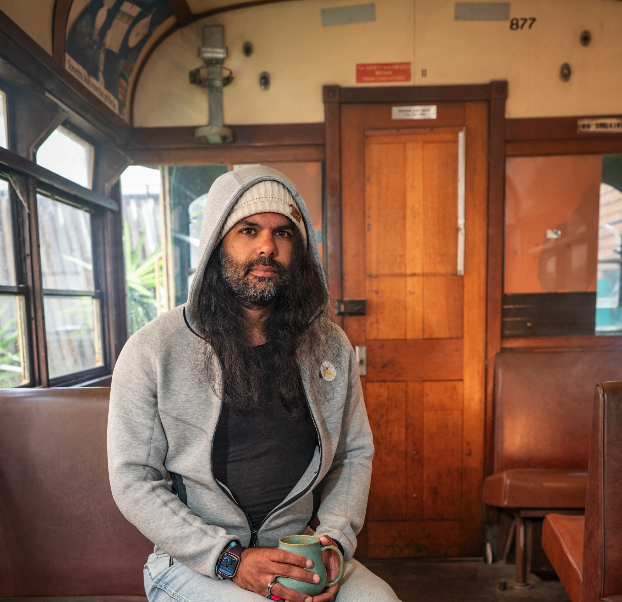
Matt Rai’s Silence As Bombs Fall Down exists in a space of quiet intensity, where restraint meets emotional weight and vulnerability sits alongside defiance. In this interview, Matt opens up about the personal revelations and lived experiences shaping the project, from neurodivergence and global perspective to the power of simplicity in songwriting and what quiet resistance really means.
Silence As Bombs Fall Down feels built on contrast, restraint versus release, quiet versus defiance. What drew you to explore that tension, and how does it reflect where you are personally right now?
I was listening to Pink Moon by Nick Drake, and there’s something in that record, this quiet confidence that still feels shy, almost withdrawn. That tension really stayed with me, and I wanted to explore my own version of that.
A big part of that comes from more recent self-understanding. My son River was diagnosed with ADHD and autism, and through that process, I recognised a lot of the same traits in myself. Getting that clarity has been a bit of a turning point.
The hoodie, for example, isn’t a look, it’s more of a form of self-preservation. There’s a natural instinct to stay slightly hidden. But at the same time, there’s something else underneath that, a kind of fire, a quiet defiance, and growing confidence.
I think the EP sits right in that space. Held back in some ways, but also pushing forward.
The live performance video for Bombs Fall Down captures you alone in that abandoned tram, adding a stark, almost cinematic layer to the song’s dystopian protest feel. What was important to you in translating the track into a visual space?
I have to give a lot of credit to Millie Piskopos for the visual side of things. I’d approached a few people with the brief, but she really understood it straight away.
A big part of that was the idea of “confident but shy,” and bringing in elements of ADHD and autism. Millie connected with that on a personal level, being neurodivergent herself, which made a real difference in how the concept came to life.
Visually, it was important to ground it in Melbourne. The tram felt symbolic, it’s been my home for over 15 years now, so it added a sense of place and identity to the piece.
More than anything, I wanted the video to carry that same feeling as the track, something intimate, a bit restrained, but with an underlying sense of defiance. I think Millie captured that beautifully.
Your music is completely stripped back, just voice and 12 string guitar. In an era of heavy production, what does removing everything else allow you to say more truthfully?
I originally wrote these songs about 20 years ago with a band. When I moved to Australia, I wasn’t in that environment anymore, so I had to reinvent them.
That ended up being a good thing. It forced me to really trust the songwriting. Stripping everything back meant the lyrics and melodies had nowhere to hide, and I think they actually come through more clearly because of that.
A lot of music now is well-produced, but sometimes the production can overpower the song itself. I wanted this EP to feel different. More like it’s speaking quietly, rather than shouting to be heard.
In a way, it’s for people who connect with the core of a song. Just voice, guitar, and whatever truth sits underneath it.
You have lived in multiple countries and worked across very different fields, from firefighting to founding Schools for Nepal. How do those experiences shape the emotional core of your songwriting?
I’ve been lucky to live in a few different places, the UK, India when I was younger, Canada, and now Australia, and I’ve spent a fair bit of time in Nepal as well.
Being exposed to different cultures and ways of life definitely shifts your perspective. You start to see how people live, what they value, and how communities hold each other together, especially in places like India and Nepal.
There’s a kind of beauty in the messiness of it all, and a strong sense of connection that really stayed with me. I think that’s influenced the emotional core of the EP, that awareness of both struggle and community, and how those two things often sit side by side.
There is a strong sense of stillness in your work, but also an undercurrent of unrest. Do your songs begin as a form of processing, or do they arrive more as observations of the world around you?
The songs mostly began as observations of the world rather than something purely personal. Books like The Rape of Nanking and Man’s Search for Meaning definitely shaped the mood, especially in Silence As….
They explore themes that I don’t really talk about in everyday conversation. They’re a bit heavier, and most people understandably stick to easier topics.
So the songs became a space to process and express those thoughts, particularly around global events and the last couple of decades. A way of quietly holding those reflections, rather than trying to explain them out loud.
Artists like Jeff Buckley and Nick Drake are often associated with vulnerability and space. How do you approach carrying that lineage while still carving out something distinctly your own?
If people hear echoes of Jeff Buckley or Nick Drake in the songs, that’s honestly the biggest compliment.
There are definitely elements in there, some of the chord progressions Buckley used, and that sense of intimacy you get from Nick Drake. Those artists have had a big influence on me.
At the same time, I can’t play guitar like Buckley or write like Nick Drake, so I’ve never tried to copy them. It’s more about taking inspiration and letting it filter through in my own way.
It’s similar with someone like Marvin Gaye, who’s one of my favourite vocalists. I’ve covered I Heard It Through the Grapevine, and there’s no way to sing that like him. You have to find your own version of it.
So I think what comes out is a mix of influence and limitation, but also interpretation. And somewhere in that, something that feels like my own starts to take shape.
The title track moves from reflection into something almost quietly confrontational. What does resistance mean to you in the context of this EP?
Some of the people I’ve always looked up to are figures like Mahatma Gandhi and Martin Luther King. Their ideas around nonviolent protest and civil disobedience have really stayed with me.
That spirit runs through Silence As… and Bombs Fall Down. It’s not about staying quiet, it’s about choosing how you speak. There’s a kind of quiet resistance in calmly pointing out injustice, rather than reacting with more noise.
For me, resistance in this EP is about that balance. Holding your ground, speaking honestly, and trying, in whatever small way, to make things a little better.
Watch to ‘Bombs Fall Down’ below